How ai impacts
theoretical
computer science.
Discover how ai impacts theoretical computer science through clear explanations of algorithm discovery, automated proofs, complexity research, and the people behind the papers. Start with the ideas that matter, then follow the evidence back to its source.
Start exploring Read the research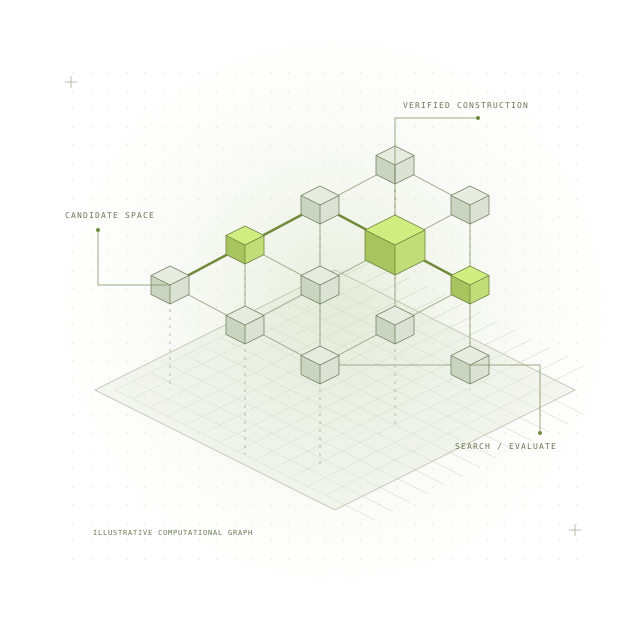
Understand the discoveries.
Examine the evidence.
Explore what comes next.
Our focus is simple: make difficult research understandable without losing the details that determine what a result actually means. Whether you are studying computer science, following AI research, or exploring a new academic direction, this is your starting point.
Understanding how ai impacts theoretical computer science requires more than collecting impressive headlines. It means asking what changed, under which assumptions, and how the result was checked. Those questions guide our coverage, reading recommendations, and explanations.
The foundations.
The new possibilities.
To understand how ai impacts theoretical computer science, begin with the field itself. Theoretical computer science investigates algorithms and the capabilities and limitations of computation. MIT describes algorithm design and complexity theory as central parts of this landscape. Source: MIT, Theoretical Computer Science.
Our coverage asks how ai impacts theoretical computer science at specific points in research: searching for useful constructions, proposing arguments, exploring algorithms, and checking formal proofs. Each activity deserves its own explanation rather than a single sweeping verdict.
A faster implementation, a better mathematical bound, and a newly proved theorem are different achievements. We help you recognize those differences before evaluating their significance.
For readers investigating how ai impacts theoretical computer science, that foundation makes the rest of the subject easier to navigate. Start with an overview, choose a research area, and build toward the original literature at your own pace.
A different way
to find an algorithm.
AlphaTensor offers a concrete example of how ai impacts theoretical computer science through algorithm discovery. Its Nature paper describes reinforcement learning for finding matrix multiplication algorithms, including improvements for particular matrix sizes and arithmetic settings. Read: Discovering faster matrix multiplication algorithms with reinforcement learning.
The important question is what was optimized. Fewer arithmetic operations, lower measured runtime, and better asymptotic complexity are distinct targets. A result should be read against the objective and setting actually studied.
Explaining how ai impacts theoretical computer science therefore requires attention to the problem formulation. Our algorithm coverage follows the search space, the evaluation method, the resulting construction, and the comparison with earlier work.
This is how we make discussions of how ai impacts theoretical computer science specific enough to be useful.
Small routines.
Meaningful gains.
AlphaDev provides another perspective on how ai impacts theoretical computer science and neighboring areas of computing. The researchers used reinforcement learning to discover sorting routines, with resulting improvements incorporated into the LLVM libc++ sorting library. Read: Faster sorting algorithms discovered using deep reinforcement learning.
Our explanation separates practical optimization from broad claims about computational complexity. Improving a small routine can matter in software without establishing a new general bound for every sorting problem.
That distinction is central to understanding how ai impacts theoretical computer science. We examine the input sizes, comparison baselines, hardware conditions, and correctness checks behind reported performance.
When assessing how ai impacts theoretical computer science, we encourage a precise question: which task improved, by which measure, and within which constraints?
Exploring the limits
of computation.
Research involving AlphaEvolve illustrates how ai impacts theoretical computer science through the search for combinatorial structures. Google Research describes applications to approximation hardness and the difficulty of certifying properties of random graphs. Source: AI as a research partner: Advancing theoretical computer science with AlphaEvolve.
These topics can be difficult to approach without context. Our coverage starts with the underlying question, introduces the relevant concept, and explains the contribution before discussing wider implications.
Following how ai impacts theoretical computer science means keeping the scale of each claim visible. An improvement to a particular bound deserves recognition on its own terms, with its assumptions and scope clearly stated.
Readers exploring how ai impacts theoretical computer science can follow that chain from candidate construction to verified property to research conclusion, without treating every stage as interchangeable.
From a plausible argument
to a checked proof.
Automated theorem proving is an important part of how ai impacts theoretical computer science. AlphaProof research published in Nature describes reinforcement learning in a formal mathematical environment and reports results on competition mathematics. Read: Olympiad-level formal mathematical reasoning with reinforcement learning.
Related work on Aristotle combines informal reasoning, Lean proof search, and a geometry solver. Its authors report gold-medal-equivalent performance on the 2025 International Mathematical Olympiad problems. Read: Aristotle: IMO-level Automated Theorem Proving.
These studies help explain how ai impacts theoretical computer science, while also raising questions about transfer beyond competition problems. Our articles distinguish the task evaluated from the broader research capabilities a reader might infer.
We introduce proof generation, formalization, and verification as separate concepts, then explain how they interact.
Understanding how ai impacts theoretical computer science becomes easier when you can identify the proposed argument, the formal statement, and the evidence supporting the reported result.
Propose an argument.
State it precisely.
Check the formal proof.
Beyond the
benchmark score.
To assess how ai impacts theoretical computer science, we need evaluations that reveal what systems can accomplish under stated conditions. TCS-Bench presents proof-generation tasks drawn from papers at STOC, FOCS, and SODA. Read: TCS-BENCH: Benchmarking State-of-the-Art Generative AI Theoretical Computer Science Research Ability.
The authors also evaluate a verification agent against expert judgments. That evaluation is relevant evidence, but a model-based assessment should not be confused with a formal proof certificate.
Our benchmark coverage explains how ai impacts theoretical computer science through measurable tasks while identifying what the measurements leave open.
We ask what information the system received, how outputs were assessed, and which conditions shaped the reported performance. We also distinguish reproducing a target result from independently selecting a valuable research question.
For anyone following how ai impacts theoretical computer science, these distinctions provide a more reliable basis for comparison than an isolated score or an impressive demonstration.
Find your way in.
Your reason for exploring how ai impacts theoretical computer science should shape where you begin.
For students: Start with algorithms, complexity, and proof fundamentals. Then read an accessible case study alongside its source paper. Identify the research question before studying the technical contribution.
For developers: Begin with algorithm discovery and implementation studies. Pay attention to evaluation conditions and the difference between practical performance and theoretical guarantees.
For research readers: Follow problem statements, assumptions, proof artifacts, and unresolved questions. Use our explanations as an introduction to the literature.
Each path approaches how ai impacts theoretical computer science from a different level of experience. You can move between them as your interests develop.
You do not need to understand every equation on your first visit. The goal is to build enough context to ask better questions about how ai impacts theoretical computer science and to recognize which sources can answer them.
Evidence comes first.
Our editorial approach to how ai impacts theoretical computer science starts with traceable sources. We prioritize research papers, technical documentation, and explanations published by the teams responsible for the work.
We distinguish peer-reviewed publications from preprints and institutional announcements. We also separate what authors report from our interpretation of its significance.
When explaining how ai impacts theoretical computer science, we look for the exact claim, its assumptions, the available supporting artifacts, and the limits acknowledged in the source. Missing evidence remains missing evidence; we do not fill the gap with confident language.
Publication status, formal verification, and independent replication answer different questions. Our coverage treats them separately.
This approach helps readers evaluate how ai impacts theoretical computer science without relying on a headline alone. Follow the references, compare the claims, and use the original work to decide how much confidence a conclusion deserves.
A field in motion.
Keep asking questions.
The most useful way to follow how ai impacts theoretical computer science is through specific questions. Which research tasks benefit from automated search? What makes a generated proof trustworthy? How should a promising result be compared with established work?
As you investigate how ai impacts theoretical computer science, look beyond a system's name to the contribution itself. A clear problem statement and a carefully supported result offer more lasting insight than a dramatic prediction.
Make this your starting point for understanding how ai impacts theoretical computer science: discover the ideas, examine the evidence, and build your own informed perspective.